
Paid ads for digital products work only when the product, buying journey and numbers work together. A download can cost little to deliver and still be too expensive to advertise. Before choosing Meta, TikTok, Pinterest, Google, Microsoft or Snapchat, work out what one completed order can afford.
1. Work backwards from the money left after a sale
The selling price is not your advertising allowance. Payment and platform fees, discounts, refunds, support and delivery costs can all reduce what remains. Use your own statements and a consistent treatment of taxes. Do not assume that a digital product has no costs because there is no parcel to ship.
A fictional $15 reading-planner bundle
Assume a $15 sale, $2 in combined payment/platform fees, $1 in expected refund losses and $1 in variable support/delivery costs. These are invented inputs for the calculation, not current fees charged by any named marketplace.
An $11 acquisition cost would use the entire contribution. If you want $4 left per order before fixed overhead, tax and owner pay, the target acquisition cost becomes $7.
For this example, break-even return on ad spend is $15 ÷ $11 = approximately 1.36. A ROAS of 1.5 would leave only $1 per order after the assumed variable costs and advertising: $15 revenue − $4 costs − $10 ads. Revenue growing faster than ad spend does not automatically mean there is enough profit to run the business.
If your recorded revenue already excludes refunds, do not subtract the same refunded revenue again. If fees differ by order or sales channel, use an appropriate average or calculate each order separately. The aim is one consistent ledger, not a reassuring dashboard number.
| Click-to-purchase conversion rate | Calculation | Maximum CPC |
|---|---|---|
| 1% | $7 × 0.01 | $0.07 |
| 2% | $7 × 0.02 | $0.14 |
| 3% | $7 × 0.03 | $0.21 |
These rates and click prices are scenarios, not benchmarks or forecasts. Your observed results may be worse or better. At $0.50 per click and a genuine 2% click-to-purchase rate, acquisition cost would be $25. That does not fit this $15 offer. Changing the channel name cannot repair that arithmetic.
2. Choose a channel your product can support
A printable moving checklist, a reading journal and a spreadsheet calculator do not all need the same advertisement. Match the product to a clear demonstration or purchase question. The following is an editorial decision aid, not a ranking of platforms by profitability.
| Channel | A useful starting hypothesis | What to verify |
|---|---|---|
| Meta | A recognisable everyday task can be shown with a real product preview. | The ad promise, landing page and completed-purchase event agree. |
| TikTok | A short demonstration makes the file’s use obvious. | Website sales and TikTok Shop are different routes with different requirements. |
| A visual planning idea maps to a specific downloadable tool. | The Pin leads to the same product; saves and purchases are measured separately. | |
| Google Search | People explicitly search for the kind of download you sell. | The actual search terms show buying intent; Shopping eligibility is a separate question. |
| Microsoft Search | You have a specific search offer and can measure purchases. | Conversion tracking is supported by your destination; demand exists in your market. |
| Snapchat | You can show the product naturally in a vertical mobile demonstration. | Audience fit, ad eligibility, mobile checkout and digital delivery all work. |
Meta: show the task getting easier
A reading planner ad could show a reader choosing the next book from a shortlist and recording a short review. That is more informative than a stack of closed book mockups. Test distinct explanations of the same offer before changing the product, audience and price together. Use the Meta guide for a creative test plan and purchase-tracking checks.
TikTok: demonstrate the download before describing the dream
Show the actual file opening and one action inside it. A viewer should know whether it is a printable PDF, an editable spreadsheet or another format. TikTok supports a website-sales route; that is separate from eligibility to sell inside TikTok Shop. See TikTok’s website-sales documentation and our digital-product video storyboard.
Pinterest: connect an idea to a usable page
For an apartment-planning workbook, show a furniture measurement page with enough detail to read a heading and understand its purpose. The caption, Pin title and destination should all describe the same use. Do not substitute “all-in-one life planner” on the sales page when the ad promises an apartment measuring tool. The Pinterest guide includes a search-to-preview worksheet.
3. Use Google and Microsoft Search for a specific buying question
Start with the words someone would use to find the finished product. “Printable reading journal PDF” and “apartment moving checklist download” are illustrative buying-intent candidates. “How to read more” is a different problem: a useful article might answer it without selling a file. These examples are not verified high-volume or low-cost keywords.
Write down the expected destination for each query before building the campaign. If you cannot point to the exact page or worksheet that answers the query, the offer is too vague. Review the actual search terms after launch. Even exact match can include searches with the same meaning or intent; it is not a promise of literal wording. Google explains its keyword matching options.
Separate Search advertising from Shopping. Google Merchant Center lists digital books among unsupported Shopping content. That restriction should not be generalised into “Google bans advertising PDFs,” nor interpreted as approval for every other file type or campaign. Check the specific product, destination and ad format against the relevant policies. Google’s unsupported Shopping content guidance.
For Microsoft, verify measurement before copying over a search campaign. Its UET system supports conversion goals, but you need a destination where the required tracking can be implemented. A marketplace URL is not proof that you can install a tag or verify a purchase. Check your storefront’s integration options and applicable consent settings. Microsoft’s conversion-tracking overview.
A search-offer worksheet
- Query hypothesis: printable apartment moving checklist.
- Included proof: a readable packing sequence, address-change checklist and moving-day page.
- Ad promise: organise the move with a printable checklist bundle.
- Destination: that bundle’s page, with file formats, sizes, price and previews.
- Exclude or separate: searches clearly looking for a removal company, free advice or a physical notebook.
Use the observed query and its intent to decide what to exclude. A word such as “template” can describe a paying customer as easily as a free-resource seeker; do not block it automatically.
4. Test Snapchat only with a clear mobile use case
A phone-first demonstration could show someone checking room measurements while planning a first apartment. Start with the useful action, then show the relevant page and the download format. A luxury desk scene alone does not explain why the file is worth buying.
Snapchat offers several ad formats, including single-image and video ads. Choose a supported format and inspect the destination on a phone before spending. The product in the ad, the seller identity and the landing-page offer need to agree. Review Snapchat’s ad formats and advertising policies.
There is no evidence here that Snapchat will be cheaper for your download, or that a particular age group will buy it. Treat both demand and acquisition cost as open questions. If your buyer research does not support the channel and you have no suitable creative, put the first test elsewhere.
5. Write the experiment before spending
- Choose the exact offer. Record its price, included files and supported software. Keep these constant during the first creative comparison.
- Calculate the target acquisition cost. Use real costs when available and mark estimates. Set a total loss limit you can afford; platform minimums do not define your business budget.
- Verify the purchase path. Complete an authorised test transaction or supported test checkout, inspect delivery, and confirm the expected event, currency and value.
- State the hypothesis. For example: showing a completed review page helps readers understand the journal better than a closed-cover mockup.
- Choose a review point. Define a date and spend cap in advance. Allow for the attribution and conversion delay you have chosen. Stop immediately for broken checkout or misleading claims.
- Change the failed component. A broken file needs a product repair; a missing event needs a measurement repair. Neither is solved by buying more clicks.
One purchase is useful evidence that a path can work, not a reliable acquisition-cost estimate. Zero purchases from a tiny sample does not establish that nobody wants the product. Record uncertainty alongside the result instead of announcing a winning channel from too little information.
6. Make the product and its preview worth the click
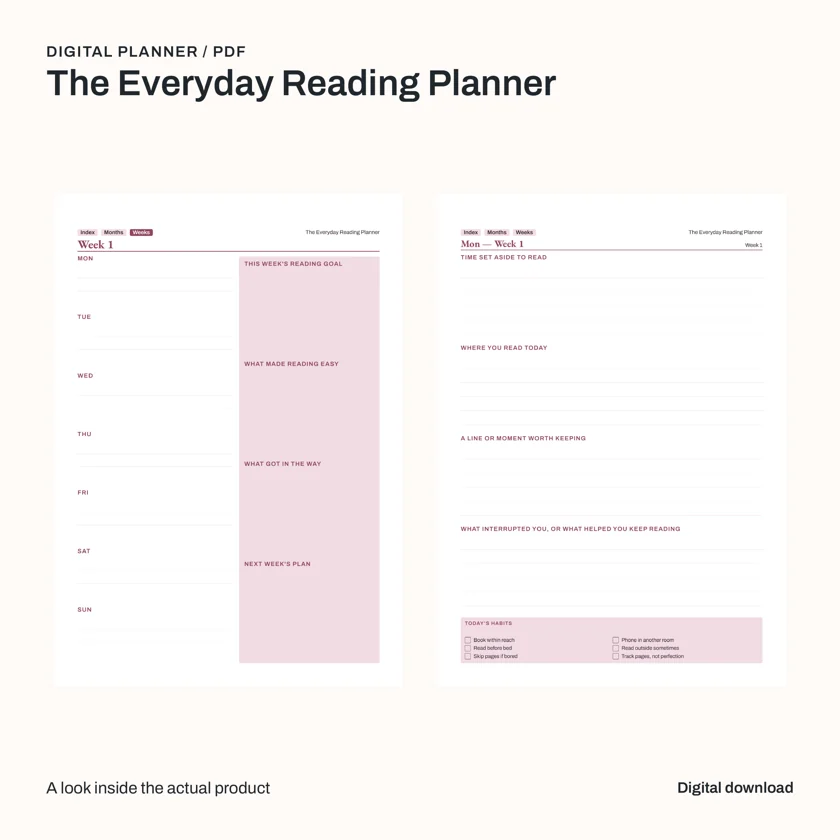
Open the final export yourself. A planner needs usable writing space; a workbook needs exercises that lead somewhere; a spreadsheet needs clear inputs and tested formulas. The cover earns attention, but the interior must support the promise. A readable page close-up often explains more than another decorative mockup.
If the arithmetic does not support paid acquisition, you can improve the offer, test demand through existing audiences or search content, or pause. Adding files to justify a higher price only helps if they solve connected buyer tasks. A coherent moving kit is easier to explain than a random bundle of fifty unrelated templates.
Common questions
Which ad platform is best for digital products?
There is no universal winner. Choose based on the customer’s task, how clearly the product can be demonstrated, measurable buying intent and the purchase cost the offer can support.
Can a $5 download be advertised profitably?
Possibly, but the available contribution may be small after costs. Calculate it first. Do not assume future repeat purchases or upsells will pay for the first order unless your own data supports that assumption.
Does Stredy run the advertising?
No. Stredy helps create products and prepare sales materials. Campaign setup, targeting, billing, policy approval and advertising performance are managed separately by the seller.
Start with a product you can demonstrate
Use Stredy to turn a specific consumer need into a digital product, then inspect the files and prepare accurate previews before advertising it.
Build your product →See the creation workflowEditorial note: AI-assisted writing reviewed against linked official platform guidance and documented product behaviour. Scenarios, sample ad copy and calculations are illustrative, not campaign results. Featured artwork is an AI-generated editorial illustration; the interior product samples are actual Stredy exports. Neither demonstrates sales performance. Platform features and eligibility can change. Stredy publishes this guide and offers a paid product-creation service, not advertising management.