Pinterest ads for digital products work best as a clear bridge between an idea and a usable download. A person planning a reading routine, a move or a family activity needs to see how your product fits that task. A decorative cover alone leaves too much to guess.
Start with the buyer’s task, not the broad category
“Digital planner” can mean many things: a printable sheet, a linked PDF for a tablet or an editable online tool. The buyer’s task and intended format narrow the offer. “Printable reading log for a book club” gives you a clearer design brief than “the ultimate productivity planner.”
Write three short statements before designing the Pin: what the buyer is doing, which page helps and what they will receive. If the third statement is unclear, solve the product packaging first. Advertising cannot make an ambiguous format easier to use.
| Buyer task | Candidate phrase | Useful visual proof | Destination must explain |
|---|---|---|---|
| Keep track of a book-club selection | printable book club reading log | Reading dates, notes and discussion prompts | Included pages, printing sizes and personal-use terms |
| Prepare a first apartment | first apartment planning workbook | Room measurement and essentials pages | PDF format, examples and what is not included |
| Organise household tasks | weekly home reset checklist printable | One uncluttered checklist with usable writing space | Undated use, print instructions and page count |
| Track a reading goal | reading tracker spreadsheet | Clearly labelled inputs and a real summary chart | Tested software compatibility and input instructions |
Validate phrases against customer language, current search evidence and the products you can actually deliver. Do not stuff all four ideas into one Pin or one product. Each row describes a different promise and may deserve a different offer.
Design a Pin around one readable piece of evidence
For a standard image creative, Pinterest recommends a 2:3 ratio, such as 1000 × 1500 pixels. Use its current format specifications when preparing the final upload. Pinterest’s creative best practices.
Plan the move before the boxes arrive
A short headline large enough to read on a phone.
One real workbook page
Use a close-up with legible labels, not six tiny pages nobody can inspect.
Printable PDF · See the included pages
Small, clear branding and a next step that matches the destination.
This composition is a suggested layout, not a Pinterest rule. The main principle is that each part has a job. The headline introduces the task, the interior demonstrates usefulness and the format label prevents a buyer mistaking a download for a shipped product.
Use contrast and a small number of type styles. Crop closely enough to show what makes the page useful, but do not hide defects or invent filled-in data. If entries are fictional, label them as examples. An actual export inserted into a mockup is easier to verify than a generated image that redraws the page.
Create a small set of genuinely different concepts
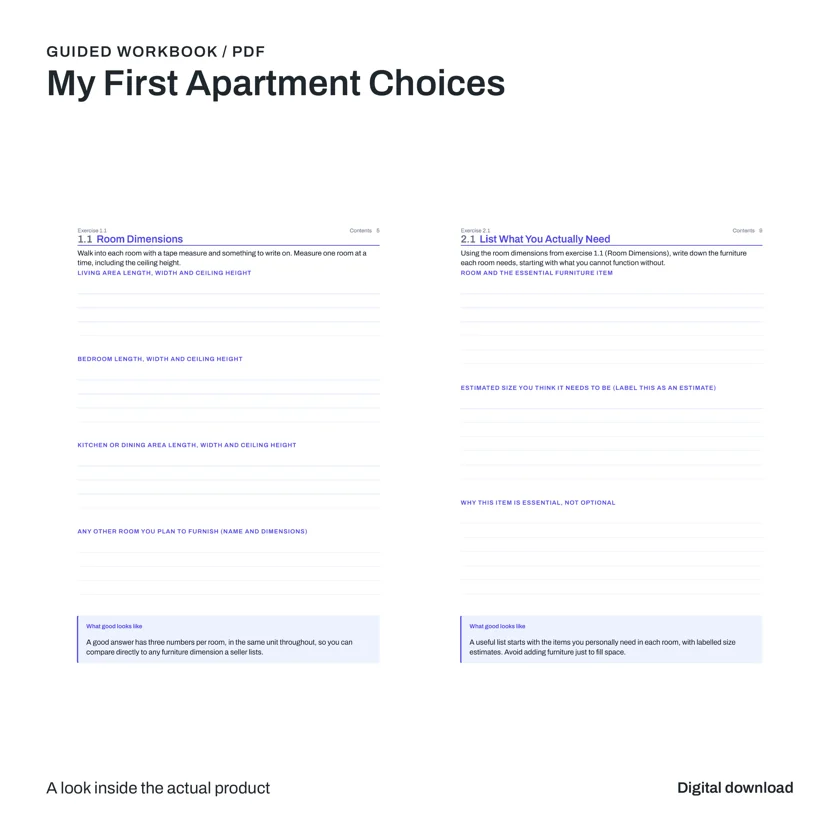
For one apartment workbook, three concepts could explain three related jobs: measuring a room, prioritising essentials and coordinating moving-day tasks. These are useful variations because each answers a different buyer question. Three colour changes to the same cover tell you less about why someone might want the product.
Example copy for a room-measuring page
Headline: Measure the room before choosing the furniture
Description: A printable apartment-planning workbook with space to record room dimensions, compare essentials and organise moving tasks. Preview the included PDF pages and printing sizes before you buy.
Visual: The real measurement page beside a clearly labelled example, with “Printable PDF” visible.
Use this only if those pages are present. Avoid promising the workbook prevents every ordering mistake; it supplies a place to organise measurements, not a guarantee.
Check the route: a Pin, an ad and a catalog are different
Do not assume that permission to share a link means a product qualifies for every shopping feature. Advertising and merchant/catalog requirements are separate checks. Review the actual product, destination and account against Pinterest’s advertising guidelines and merchant guidelines.
As checked on September 28, 2026, the merchant page announced an update effective November 12, 2026. A future-policy preview is not the current policy. Check the effective date when you launch, especially if you are setting up product feeds or a merchant program. This guide does not promise that a particular digital download qualifies for catalog distribution.
The practical preparation is the same regardless of the route: use a working product page, accurate price and format information, clear seller contact/support information and an honest description. A polished Pin cannot compensate for a broken checkout or a listing that conceals what is being sold.
Measure the purchase you can actually observe
For a storefront you control, confirm that the required tracking can be installed and tested. Pinterest’s event documentation identifies Checkout as the completed-purchase event. Verify the current event requirements for the campaign you intend to use. Pinterest event-code documentation.
For a marketplace destination, first check the integrations available to that seller account. Do not assume you can add an arbitrary tag to a page you do not control. If you can observe outbound visits but cannot reliably connect purchases, report that limit. An unmeasured purchase is not automatically a failed sale, and an outbound click is not a verified purchase.
Keep distinct records for impressions, saves, outbound visits, checkout activity and orders. Saves can tell you a creative has planning value; they do not tell you whether the offer can support advertising costs. Compare results using the same date range, currency and attribution settings.
Run a bounded test and keep the interpretation modest
Choose one product and one meaningful creative question. For example: does a close-up of the room-measurement worksheet explain the offer better than a bundle overview? Keep the price and destination consistent so you can interpret the comparison.
Before spending, calculate the amount left after fees, expected refunds and variable servicing costs. Set a total spend cap and a review point. Do not adopt another seller’s click price or conversion rate as your forecast. A campaign that produces sales can still leave too little contribution to be worthwhile.
- The Pin and landing page show the same product and format.
- The headline and preview remain understandable on a phone.
- The purchase path and download have been checked.
- Tracking limitations are written down before results are interpreted.
- The experiment has a spending limit and one primary commercial question.
If people save the Pin but do not visit, inspect whether the image gives away the entire answer or leaves the product’s value unclear. If they visit and misunderstand the format, fix the destination. If orders occur but costs exceed your margin, investigate the offer economics. These are questions to test, not conclusions that the metrics alone can prove.
Common questions
Can I send a Pinterest ad to Etsy or Gumroad?
Check the current destination and product policies, then confirm which measurement features your storefront supports. A working product link does not by itself establish ad eligibility or completed-purchase tracking.
Should every Pin use the same brand template?
Use consistent typography, colours and branding, but adapt the visual evidence to the task. A spreadsheet input needs a different close-up from a printable writing page.
Can I reuse the cover as the whole ad?
You can test it where permitted, but a cover mainly identifies the product. An interior preview can explain what the buyer will actually do with it. Choose the image that answers the buyer’s question.
Create the product behind the Pin
Use Stredy to build a focused digital product and supporting sales assets. Inspect the exported pages, then choose the clearest real preview for your campaign. Advertising remains under your control.
Build your product →Explore consumer product ideasEditorial note: AI-assisted writing reviewed against linked official platform guidance and documented product behaviour. Scenarios, sample ad copy and calculations are illustrative, not campaign results. Featured artwork is an AI-generated editorial illustration; the interior product samples are actual Stredy exports. Neither demonstrates sales performance. Platform features and eligibility can change. Stredy publishes this guide and offers a paid product-creation service, not advertising management.