

AI agents for digital product creation are useful when each stage produces something another stage can check. “Research agent” and “design agent” are only labels until they have a clear brief, a concrete deliverable and a way to recognise a bad result.
Give the workflow one consumer problem
Start with a person and a task. “Create a digital product about productivity” leaves almost every important decision open. “Create a printable reading journal for people who collect book recommendations but lose track of what they wanted to read” gives the work a direction.
A reusable product brief
- Buyer
- An individual reader keeping a personal book shortlist.
- Task
- Record recommendations, choose the next book and write a short reflection.
- Product
- An undated printable PDF journal with clearly named sections.
- Minimum useful contents
- Shortlist, reading log, brief review page, borrowed-book log and simple instructions.
- Design requirements
- Readable type, generous writing space, consistent labels and printable contrast.
- Boundaries
- No copyrighted book excerpts, invented endorsements or claims that it guarantees a reading habit.
- Sales promise
- A downloadable journal that helps organise reading notes, with real page previews.
This is an illustrative brief, not evidence that the niche has validated demand. Research should still establish whether the intended buyers want the tool. A precise brief reduces ambiguity; it does not replace demand validation.
Assign responsibilities with visible handoffs
The following is a practical acceptance framework for evaluating an agent-assisted workflow. It is not a promise that every named role exists as a separate autonomous process in Stredy. Some work is better performed by ordinary code, templates or a human check.
| Responsibility | Required deliverable | Acceptance question |
|---|---|---|
| Research | Buyer problem, evidence links and clearly marked uncertainties | Does the evidence support the claimed need and any factual assertions? |
| Planning | Contents map tied to the buyer’s task | Does every section earn its place? |
| Writing | Complete instructions, prompts, examples or chapters | Can a buyer use it without guessing what to do? |
| Design | Consistent typography, spacing, colour and page treatments | Is it readable and functional at the intended size? |
| Rendering | Actual PDF, EPUB or spreadsheet files as supported | Do the files open correctly in the intended software? |
| Validation | Specific pass/fail findings and a repair target | Was the actual export checked, not just its source data? |
| Sales assets | Accurate cover, previews, mockups and listing copy | Do all claims and images match the delivered product? |
A useful handoff contains both the artifact and its constraints. The writing stage should know the available page space; the design stage should know which fields need handwriting room; the sales stage should know the exact formats delivered. Otherwise, each stage can produce something plausible that does not fit the final package.
Use different quality checks for different products
Planners and trackers: the space is part of the product
Open a page at its intended print size. Can someone write in the boxes? Are repeated labels useful, or do they consume half the page? Are dates, week boundaries and navigation correct? A planner with elegant headings and cramped writing areas is not finished.
Calendar arithmetic should be computed and checked, not guessed in prose. Stredy’s planner implementation separates calendar structure from AI-written prompts and instructions. That is a useful design principle: ask the model for language and use deterministic logic for dates and repeated structure.
Workbooks: each exercise needs a purpose and a next step
A prompt such as “Reflect on your goals” is incomplete on its own. Add a concrete question, space or fields to answer, a small example where helpful, and an explanation of how the answer will be used. Remove exercises that repeat the same thought under different headings.
Guides and ebooks: check the argument across chapters
Review the contents as a sequence. A chapter should answer a question, explain a concept or help the reader take a step. Check references and examples against their sources. Do not let a fluent paragraph invent research, quotations or statistics. Read transitions as well as individual sections.
Spreadsheets: test the behaviour, not the appearance
Separate editable inputs from calculated cells, explain the units and check blank, zero and ordinary inputs. Test boundary cases relevant to the template. A chart should reflect actual worksheet values. A beautiful dashboard with a broken total is an unfinished product.
A small spreadsheet acceptance test
For a fictional reading tracker, enter two completed books with 120 and 180 pages. The completed-pages total should be 300. Add an unfinished 200-page book: a total explicitly labelled “pages in completed books” should remain 300. If the dashboard instead counts pages read so far, the inputs and formula need a different definition.
The lesson is not that every tracker should use this formula. It is that labels, inputs and calculations must describe the same thing. Test the definition the buyer sees.
Make visuals explain the contents
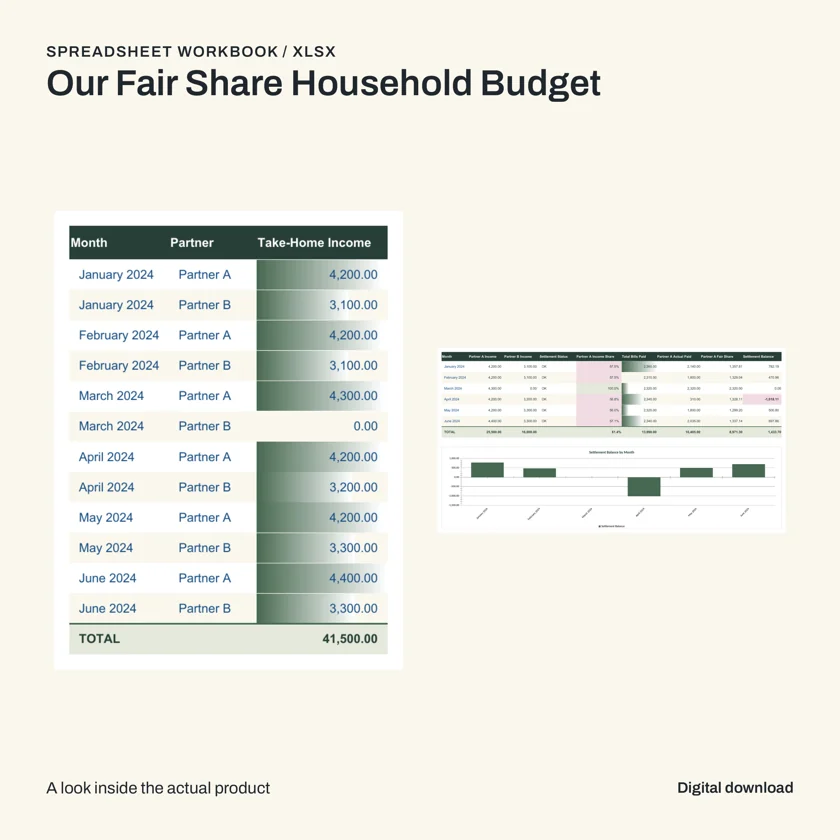
A diagram can show the sequence from shortlist to current read to review. Icons can help identify repeated sections. A chart can reveal a pattern in actual entered data. Each has a purpose beyond filling empty space.
Ask what the image helps the buyer understand. If the answer is only “it looks premium,” it may belong on the cover rather than inside an exercise. If a chart needs invented numbers to exist, replace it with a labelled conceptual diagram or omit it. Decorative charts should never masquerade as evidence.
For mockups, use the actual cover or page image inside the scene. Keep the title legible and avoid showing features that are not in the package. Label the file format and distinguish digital delivery from physical objects used as props.
Spend effort on the failed component
A cost-conscious workflow saves approved progress. If one table overflows, repair its layout and recheck affected pages. If one formula is wrong, correct and retest that calculation. Regenerating the entire product can introduce fresh defects into sections that were already useful.
Reuse a coherent design system for typography, spacing and repeated components. Give the model only the context needed for the current task. Produce a structured contents plan before requesting long-form text. Bound repair attempts and make persistent failures visible. These are engineering principles, not a guarantee of a particular token saving or completion time.
Do not reduce cost by removing the checks that establish whether the buyer can use the file. A cheaper generation is poor value if it produces a download that cannot be opened. Compare completed, usable packages and their total cost, including retries, rather than comparing only the first text request.
Keep the seller in the final review
Before listing the product, open every delivered format. Inspect representative pages and any dense table, chart or exercise. Try the instructions from a buyer’s perspective. Confirm the listing’s page count, formats, compatibility and contents against the files, then complete a supported delivery test.
- The package solves the specific task in the brief.
- The actual export opens and remains readable at the intended size.
- Facts and references are traceable; examples are labelled.
- Inputs, formulas, dates and navigation behave as described.
- Images and mockups accurately show the delivered product.
- The sales description makes no unsupported outcome or compatibility claims.
For platform-specific preparation, read the Gumroad packaging guide and consumer product ideas for Etsy. KDP preparation applies only to eligible products and requires the seller to complete the upload and review process. An export package is not automatic publication or marketplace approval.
Common questions
Are more AI agents always better?
No. Extra stages can add coordination work and repeat information. A small workflow with clear responsibilities and reliable checks may be more useful than many agents passing vague instructions to each other.
Can an agent guarantee an error-free product?
No. Good checks reduce avoidable defects and make failures easier to repair, but they do not establish perfection. Inspect the exported files and keep a way to correct issues found by real users.
What should I look for in an AI digital product creator?
Look for supported output formats, product-specific structure, real export previews, truthful sales assets and understandable failure handling. A long feature list is less informative than a finished sample you can open and evaluate.
Turn the brief into a product you can inspect
Stredy helps create digital products and their sales materials. Start with a focused buyer task, review the result and publish only what accurately represents the files you deliver.
Create with Stredy →Read the full creation workflowEditorial note: AI-assisted writing reviewed against linked official platform guidance and documented product behaviour. Scenarios, sample ad copy and calculations are illustrative, not campaign results. Featured artwork is an AI-generated editorial illustration; the interior product samples are actual Stredy exports. Neither demonstrates sales performance. Platform features and eligibility can change. Stredy publishes this guide and offers a paid product-creation service, not advertising management.