
Meta ads for digital products need to make a file feel useful before asking someone to buy it. A beautiful planner cover can win a glance. A readable page showing how the planner helps organise a week gives the buyer a reason to keep looking.
Make one clear offer, with an honest boundary
“Transform your life with the ultimate digital planner” does not tell someone what they receive. A sharper offer might be: “A printable reading journal for choosing your next book, recording short reviews and keeping track of borrowed books.” It names the job, the contents and the format.
The same discipline applies to a family activity workbook or home-maintenance spreadsheet. Sell the usable tool rather than a guaranteed personal outcome. A tracker can organise information; it cannot promise that every buyer will become more disciplined, save a fixed amount of money or reach a health goal.
The task
Choose a book without losing the recommendations you have collected.
The proof
Show the shortlist page and one completed review using clearly fictional entries.
The boundary
Printable PDF. Personal use. No physical notebook or editing software included.
Before advertising, put the exact price, included formats, page sizes, software needs and delivery instructions on the product page. If a mockup shows a tablet, explain whether the file is a PDF that can be annotated in a separate app. A device frame should not imply that you sell an app or provide the device.
Build three ads that answer different buyer questions
Start with one product, one price and one destination. Vary the explanation. This makes it easier to learn whether people need to see the product in use, understand the package or solve a particular task.
| Concept | What to show | Sample opening | Question it tests |
|---|---|---|---|
| Use it | A real shortlist page, then a review being filled in | “Keep the book recommendation. Add the reason you wanted to read it.” | Does a demonstration clarify the value? |
| See inside | Three readable interior close-ups, with their page names | “Your next read, your last review, your borrowed books—in one printable journal.” | Do buyers need to understand the contents? |
| One small task | Select a title from a populated shortlist | “Pick your next book from a list you actually remember.” | Does a narrow use case beat a broad promise? |
Label example entries as examples and avoid showing private customer information. Record the actual exported PDF or spreadsheet. Do not manufacture an animated dashboard the buyer will never receive. If the product is static, the motion should be in the demonstration, not an invented feature.
For Reels, prepare a vertical version with readable text away from interface overlays and audio you have permission to use. Meta’s official Reels guidance emphasises vertical creative, safe placement of key messages and appropriate audio. Preview each placement instead of assuming one crop works everywhere.
Example ad copy
Primary text: Keep your reading shortlist, quick reviews and borrowed-book notes together. This printable reading journal includes separate pages for each task, with space to write. Preview the pages before you buy.
Headline: A reading journal you can see inside
Destination promise: PDF download · page previews · printing instructions
Use this wording only for a product that actually includes those elements. It is a drafting example, not a claim about every Stredy export.
Make the landing page continue the same conversation
A person who clicks the “borrowed books” demonstration should quickly find that page in the listing. Keep the opening product image recognisable, show the price before checkout, and make the download format unambiguous. Send the visitor to the specific offer, not a storefront where they have to search again.
A useful listing sequence is: what it helps you do; two or three real interior previews; what is included; compatibility and printing information; delivery and support; purchase action. You do not need a long sales letter to explain a simple file. You do need enough detail to remove predictable uncertainty.
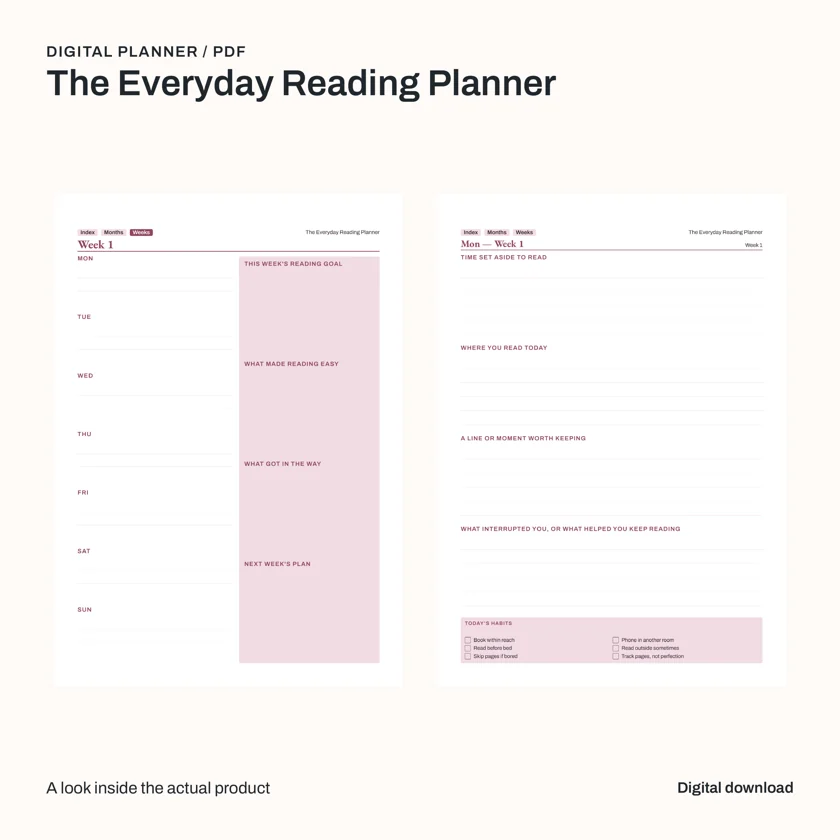
Open the page in the same kind of mobile journey an ad visitor will use. Check that the purchase button is accessible, the preview text remains readable and the file can be downloaded after checkout. A desktop-only review misses friction that can occur before the buyer ever reaches the product.
Verify Gumroad purchase tracking before judging the ads
Gumroad supports a native Meta Pixel field and sends ViewContent, InitiateCheckout and Purchase events. If you use Meta’s allowed-domain list, include both your Gumroad subdomain and gumroad.com: the receipt and purchase event use gumroad.com. Gumroad’s native integration does not include Meta Conversions API. See Gumroad’s current analytics documentation.
Treat those capabilities as a starting point, not proof that your setup is working. Use the platform’s testing tools and an authorised test purchase or supported test mode. Check the event name, order value, currency, time and destination. Do not test against a customer’s real order or repeatedly charge a card without a clear test procedure.
- Record one known test journey from the exact ad destination.
- Confirm the product page loads and the checkout remains on the expected seller’s path.
- Verify that one completed test order produces the expected purchase signal, with the correct value and currency.
- Check for duplicate reporting if more than one tracking integration is installed.
- Compare the analytics event with the order record rather than relying only on a pixel status badge.
Privacy choices, blockers, attribution windows and timing can produce differences between storefront orders and ad reports. Investigate the reason; do not secretly bypass consent to make the totals match. Keep the order ledger as the record of what was actually sold, while using advertising reports to understand attribution under their configured rules.
Set a business limit before choosing a campaign budget
Calculate the amount left from one sale after variable costs, then decide how much of that amount you can spend acquiring the order. Include a realistic allowance for refunds and support. Our paid-ads decision guide contains a worked $15-product example and explains why a positive ROAS can still leave very little money.
Write a simple experiment note: “I will test whether a real page demonstration makes this offer understandable. The product and price stay constant. I will inspect completed purchases and spend at the review point, with a fixed total spend cap.” Choose the cap from your own circumstances; there is no universal beginner budget that guarantees enough evidence.
Use a campaign goal aligned with the outcome you can measure. If your commercial question is whether the product sells, a cheap click is not the answer. When purchases cannot be measured reliably, repair the measurement or explicitly treat the exercise as a traffic/creative test. Do not present it as proof of profitable acquisition.
Diagnose the stage that failed
| Observed problem | Check before changing the campaign | Useful next action |
|---|---|---|
| Ad gets attention, few destination visits | Does the video explain the product and ask for a relevant action? | Test a clearer demonstration and CTA. |
| Clicks, but few loaded page visits | URL, redirects, mobile loading and tracking definitions | Repair the journey; do not blame the offer immediately. |
| Page visits, no checkout starts | Price visibility, preview quality, compatibility and offer fit | Clarify a buyer objection and test one meaningful change. |
| Checkout starts, few orders | Unexpected costs, payment errors, account requirements and trust | Walk through checkout on a phone. |
| Store orders, no reported purchases | Pixel destination, event mapping, privacy, timing and attribution | Compare a known order with the event trail. |
| Sales with little contribution left | Actual fees, refunds, acquisition cost and support time | Improve the economics or pause spending. |
None of these observations proves a single cause. A small sample can mislead. Keep a change log and compare like with like: the same attribution window, the same currency and the same definition of a purchase. Avoid changing five settings after one disappointing day and then claiming to know which change helped.
Common questions
Can I use AI-generated mockups in Meta ads?
Use only assets you have the rights to use and check that they accurately represent the product. A mockup that invents pages, functionality or included accessories can create the wrong expectation. A composited image containing the real cover or interior is easier to verify.
Should I advertise a bundle instead of one cheap download?
Only when the bundle solves a connected set of buyer tasks. More files are not automatically more valuable. Explain why each component belongs and check the resulting margin rather than assuming a higher price will convert.
Does this apply to Facebook and Instagram?
The offer and measurement checks apply to both. Creative treatment should still be reviewed for the placements you actually use, including crop, text size and the mobile buying journey.
Give your ad something useful to show
Build a focused product with Stredy, inspect the real export, and use its actual pages in your listing and advertising. Stredy prepares products and sales assets; it does not manage Meta campaigns.
Create a digital product →Prepare your Gumroad downloadEditorial note: AI-assisted writing reviewed against linked official platform guidance and documented product behaviour. Scenarios, sample ad copy and calculations are illustrative, not campaign results. Featured artwork is an AI-generated editorial illustration; the interior product samples are actual Stredy exports. Neither demonstrates sales performance. Platform features and eligibility can change. Stredy publishes this guide and offers a paid product-creation service, not advertising management.